
Reserve Bank of India Governor Shaktikanta Das tells Anup Roy, Raghu Mohan and Niraj Bhatt that it is time for banks to lower interest rates and start lending to cash-starved finance companies after due credit appraisal and proper risk assessment.

Traders are now focussed on the upcoming November trade data, due sometime this week, for near-term direction, with consumer inflation data due out on Thursday, which will help set expectations ahead of the Reserve Bank of India's policy review on December 18.

'The Indian economy is in slowdown and growth may stay slow,' notes Devangshu Datta.

Deadline to submit convincing reform plans is this week.

Domestic equity investors' wealth eroded by more than Rs 4.43 lakh crore on Monday as fears of a financial contagion triggered by one of the biggest bank failures in the US roiled market sentiments. After a strong opening, Indian stocks went into a tailspin with the benchmark 30-share BSE Sensex tumbling nearly 900 points to close at 58,237.85 points -- sliding for the third straight trading session. The NSE Nifty too declined 258.60 points to end at 17,154.30 points.
He was referring to the issue of Indians allegedly stashing unaccounted money in Swiss banks.

The 30-share Sensex ended down 245 points at 28,799 and the 50-share Nifty closed down 81 points at 8,750

The sell-off was probably aggravated by computer-driven traders

Enthused by the upbeat mood visible about India at the World Economic Forum in Davos, eminent banker Uday Kotak said investors now want to see some real action on the ground.

The V-shaped rebound has been aided by a gush of liquidity flooding the global financial system, thanks to balance sheet expansion.
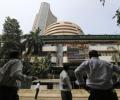
The broader NSE Nifty dropped by 48.65 points, or 0.45 per cent to 10,808.05 after shuttling between 10,773.55 and 10,833.70.

On February 22, 2013, the Reserve Bank of India issued guidelines on 'Licensing of New Banks in the Private Sector'.

The result of the opinion polls would allow the government to move ahead quickly to reach a deal with creditors

Reserve Bank Governor Shaktikanta Das on Thursday said the central bank's asset purchases, aimed at mitigating COVID-19-related liquidity stress in the system, did not dilute its balance sheet or compromise on core principles of central banking. In the wake of the pandemic, the RBI undertook several conventional and unconventional measures. "Unlike many central banks, the RBI's asset purchases did not dilute its balance sheet and hence, did not compromise on core principles of central banking," Das said while addressing an event organised by the Bombay Chamber of Commerce. These purchases were confined to risk-free sovereign (government) bonds including state government securities only, he said.

Participants are keenly waiting for the January IIP.

The International Monetary Fund (IMF) on Tuesday said it is expecting some slowdown in the Indian economy next fiscal year and projected the growth to 6.1 per cent from 6.8 per cent during the current fiscal ending March 31. The IMF on Tuesday released the January update of its World Economic Outlook, according to which the global growth is projected to fall from an estimated 3.4 per cent in 2022 to 2.9 per cent in 2023, then rise to 3.1 per cent in 2024. "Our growth projections actually for India are unchanged from our October Outlook.

'The financial sector will be hit even harder than the overall market.' 'The banking sector will eventually be rescued.' 'But it may go into a long downwards spiral before things turn around.' 'Threat or buying opportunity?' asks Devangshu Datta.

The rupee ended at 59.18 compared with previous close of 59.33 to the dollar.
Some say the MPC will raise the rate, while others are of the view that there is already de facto interest rate tightening through rising bond yields, which might prompt the central bank to go for a pause.
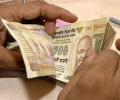
The rupee resumed marginally lower at 67.24 per dollar against Wednesday's closing level of 67.21.

Images from the Euro 2024 Round of 16 match between Austria and Turkey, at Leipzig stadium, Leipzig, Germany, on Tuesday.
The 50-issue NSE Nifty in range-bound movements settled higher by 59.15 points, or 0.58 per cent, at 10,252.10.

Closing banks and restricting the flow of capital can build pressure for a solution as finances get squeezed.

The International Monetary Fund (IMF) on Tuesday slashed India's growth forecast for 2022-23 (FY23) by 80 basis points to 7.4 per cent, citing less favourable external conditions and rapid policy tightening by the central bank. In its update to the April World Economic Outlook, the IMF said that though a global recession in 2022 was ruled out with a growth estimate of 3.2 per cent, the balance of risks was squarely to the downside, driven by a wide range of factors that could adversely affect the global economic performance. "The risk of recession is particularly prominent in 2023, when in several economies growth is expected to bottom out, household savings accumulated during the pandemic will have declined, and even small shocks could cause economies to stall.
The 30-share Sensex lost 54 points at end at 27,086 and 50-share Nifty shed 19 points to close at 8,096.
Side indices raced ahead with BSE Midcap and BSE Smallcap advancing 0.4% and 0.3% up, respectively.
.jpg)
In the offshore non-deliverable forwards, the one-month contract was at 61.58, while the three-month contract was at 62.18.

In dollar terms, the Indian markets managed to climb back to 2008 levels only in January this year. The subsequent fall in the rupee because of emerging market woes has once again pushed the markets below their 2008 level in dollar terms.

A fresh demand for the US currency from importers weighed on rupee.

The Indian unit opened sharply higher at 64.80 as against Wednesday's closing level of 65.12.

Hopes of revival and earnings growth in 2020, surprise tax cuts, and robust foreign flows - thanks to easy global monetary policies - are a few reasons why the markets have managed to digest the low GDP footprint. Select bluechips such as Reliance Industries, Bajaj Finance, Asian Paints, and ICICI Bank have gained sharply this year. On the other hand, YES Bank, Zee Entertainment, and Indiabulls Housing have seen a sharp fall.

'It is less dependent on imported capital.'

Will Greece manage to pay euro 1.5 billion to IMF?

The ruble has recouped most of its losses and become the top-performing currency globally. It continues to gain and is up 60 per cent against the US dollar from its lows in the first week of March. The ruble appreciated to 83 to the dollar intraday on Tuesday against a record low of 139 on March 7.

A crucial meet of the Reserve Bank's central board is underway amid a rift between the central bank and the government over future course of policies. Expectations of a positive outcome boosted market mood after the meeting began.

Money parked by Indians in Swiss banks rose over 50 per cent to CHF 1.01 billion (Rs 7,000 crore) in 2017, reversing a three-year downward trend amid India's clampdown on suspected black money stashed there.

Political risk culminating from elections in the US and Latin America, and evolving right-wing populism in Europe could lead to substantial volatility, say Abheek Barua & Tushar Arora.

Besides, a higher opening in the domestic equity market and strengthening of the euro against the dollar overseas supported the local currency, forex dealers said.

In the national capital, gold of 99.9 and 99.5 per cent purity were up by Rs 150 each to Rs 28,500 and Rs 28,300 per 10 gram respectively.

The Indian stock market had rallied through the first fortnight of October but it gave back the bulk of its gains in the second half.
